

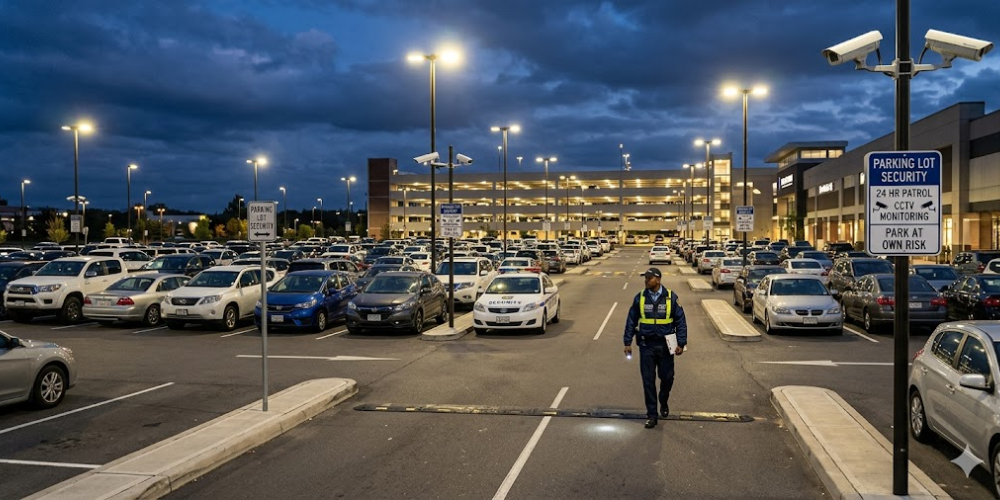
You can significantly reduce crime and liability by implementing a layered security strategy that focuses on visibility, access control, and constant monitoring. To improve your parking lot security, you must focus on upgrading lighting, installing high-definition surveillance, implementing access control, maintaining the physical environment, and deploying active patrolling.
Strategic Steps for Parking Lot Security
Upgrade to High-Output LED Lighting
Visibility is your first line of defense. Criminals avoid well-lit areas where they can be easily identified.
The Method: Replace old yellow-tinted bulbs with LED fixtures that have a high Color Rendering Index (CRI).
Aim for a minimum lighting level of 5 foot-candles in general parking areas and 10 foot-candles at entrances and payment kiosks. Ensure there are no “dark spots” or shadows between vehicles.
Install High-Definition IP Cameras
Cameras serve as both a deterrent and a tool for evidence collection.
The Procedure: Position cameras at all entry and exit points to capture license plates and facial features. Use a mix of “bullet” cameras for long-range views and “dome” cameras for wide-angle coverage.
Technical Standard: Use cameras with at least 4MP resolution and infrared (IR) night vision capabilities. For high-traffic lots, integrate License Plate Recognition (LPR) software to automatically log every vehicle that enters.
Implement Perimeter and Access Control
Restricting who can enter the lot prevents unauthorized individuals from loitering or scouting targets.
The Method: Use physical barriers like fencing, bollards, or automated gates.
The Procedure: Issue key fobs, mobile credentials, or RFID tags to authorized users. For public lots, use “Pay-on-Foot” stations located in well-lit areas to discourage cash-related crimes at the exit gates.
Maintain the Physical Environment (CPTED)
Crime Prevention Through Environmental Design (CPTED) suggests that a well-maintained lot signals that the area is monitored.
The Procedure: Follow the “2-foot/6-foot rule” for landscaping: keep hedges trimmed to no higher than 2 feet and tree canopies trimmed to no lower than 6 feet. This eliminates hiding spots for intruders.
Maintenance: Immediately repair broken fences, paint over graffiti, and replace burnt-out lights. A neglected lot often attracts criminal activity.
Deploy Active Security Patrolling
Technology is most effective when paired with a human presence. While cameras record, parking lot security guards provide an active deterrent by being physically present to de-escalate situations.
The Method: Hire uniformed security guards to perform random-interval patrols.
The Procedure: If a physical guard is not budget-friendly, use Remote Video Monitoring. This involves a live agent at a command center watching your camera feeds in real-time and using two-way audio to warn trespassers.
By combining these technical and physical measures, you create a safer environment for both vehicles and pedestrians. For a comprehensive assessment of your property, you can consult with the experts at Hyguard Services to develop a customized protection plan.
What are the Responsibilities Of Parking Security?
The responsibilities of parking security focus on maintaining a safe, organized, and law-abiding environment for both drivers and pedestrians. To manage a lot effectively, security personnel must handle access control, active monitoring, rule enforcement, and emergency response.
Core Responsibilities of Parking Security
Access Control and Traffic Management
Security is responsible for managing who enters and exits the property.
The Procedure: Guards verify credentials at entry points, manage gate operations, and direct traffic during peak hours to prevent congestion and accidents.
Key Task: They ensure that only authorized personnel or paying customers utilize the space, preventing unauthorized loitering or “overflow” parking from neighboring businesses.
Vigilant Monitoring and Surveillance
Constant observation is necessary to detect threats before they escalate.
The Procedure: This includes both physical foot or vehicle patrols and the monitoring of CCTV camera feeds.
The Goal: Security identifies suspicious behavior, such as individuals looking into car windows or vehicles circling the lot multiple times without parking.
Enforcement of Parking Regulations
To keep the lot functional, security must enforce the specific rules of the property.
The Procedure: Guards identify and document illegally parked vehicles, such as those blocking fire lanes, occupying handicap spots without a permit, or double-parking.
Action Steps: Responsibilities include issuing warnings, writing parking citations, and, when necessary, coordinating with towing services to remove vehicles that violate safety protocols.
Incident Reporting and Documentation
Clear documentation is vital for liability protection and law enforcement.
The Procedure: Security maintains a daily log of all activities and creates detailed incident reports for thefts, vandalism, or fender-benders.
Technical Standard: High-quality reports include the time of the event, vehicle descriptions, license plate numbers, and photos of any damage or violations.
Public Assistance and Customer Service
Security often serves as the first point of contact for visitors.
The Procedure: Guards provide directions, help locate vehicles, and offer “safety escorts” for employees or customers walking to their cars late at night.
The Goal: Their presence provides a sense of safety (the “deterrence factor”) while ensuring that guests feel supported while on the property.